Key Takeaways
- Renewal time is the one moment each year to confirm that your coverage still matches your home's replacement cost and your own needs.
- A current wind mitigation inspection, recorded on Florida's official OIR-B1-1802 form and submitted to your insurer, can qualify you for a discount.
- Flood damage is not covered by a standard homeowners policy, and NFIP policies carry a 30-day waiting period, so buy well before you need it.
- Review both your main deductible and the separate hurricane deductible, because they set what you pay out of pocket after a claim.
- Compare your renewal against quotes from other licensed insurers, but keep documentation for any discount you count on.
A Florida homeowners insurance renewal is more than a bill to pay, it is the one time each year you can check that your coverage still fits your home and your budget. This checklist walks through coverage limits, the wind mitigation discount, flood insurance, deductibles, and when it makes sense to compare the market before you renew.
I'm Rhonda Townsend with 1st Real Estate Solution Inc., and I help buyers and sellers throughout Palm Beach County understand the real costs of owning a home. Insurance is one of the biggest of those costs, and it is also one of the most changeable. Whether you have owned for years or are buying soon, this guide gives you a clear review to run at renewal time.
Why Review Your Homeowners Insurance Renewal?
Insurers adjust rates and terms over time, and your home changes too. Construction costs move, you may add a screened enclosure or impact-resistant windows, or your policy may quietly drop a discount you used to have. Renewal is the moment when you have the insurer's attention, which makes it the best time to ask questions and make changes. If you are buying a home soon, my guide to homeowners insurance for Palm Beach County buyers covers the same ground from the purchase side.
Check Your Coverage Limits
The most important number on your policy is Coverage A, the amount that covers the dwelling itself. It should reflect what it would cost to rebuild your home today, not its market value and not the price you paid years ago. If your policy was set when you bought and construction costs have risen since, your limit may be lower than a realistic rebuild cost, which could leave you with a gap after a total loss.
As you review your declarations page, look for:
- Replacement cost versus actual cash value: replacement cost covers rebuilding at today's prices; actual cash value subtracts depreciation, so it pays less.
- Ordinance or law coverage: this pays the added cost to rebuild to current code, which is often significant in Florida.
- Roof coverage: check how your policy values roof damage and any roof deductible or settlement terms.
- Other structures and contents: confirm limits for detached structures, personal property, and living expenses if you cannot stay in the home.
Your agent can run an updated replacement cost estimate, and it is worth doing whenever your policy renews or your home changes.
Two more numbers deserve a look: the contents limit, which covers your personal property, and loss of use, which pays for living elsewhere while your home is repaired. Both are often set as a percentage of Coverage A, so when the dwelling limit changes, they usually follow, but it is worth confirming they still match what you own. A quick mental inventory, or better, a few photos and receipts for larger items, makes a future claim much easier to settle fairly.
Claim the Wind Mitigation Discount
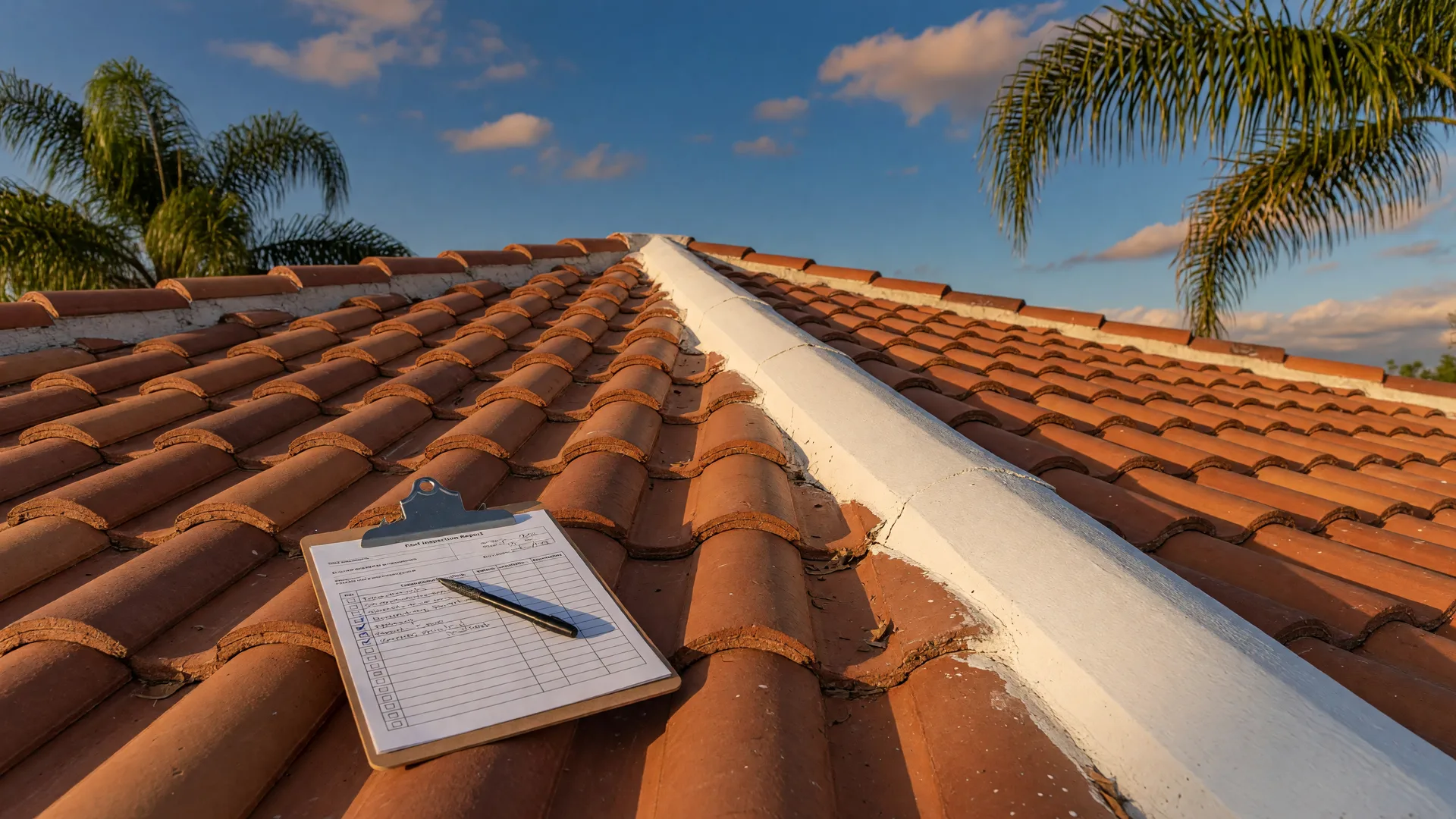
Florida law requires insurers to offer discounts, credits, or rate differentials for wind-resistant construction features. Those features include the roof covering type, roof deck attachment, roof-to-wall connections, roof shape, and impact-resistant windows and doors. The catch is that the discount only applies when you have a current wind mitigation inspection on file with your insurer, recorded on Florida's official uniform form, the OIR-B1-1802.
A wind mitigation inspection typically costs about $75 to $150, and the report is generally accepted for up to five years, so the savings can outweigh the cost several times over. If you have had a new roof or impact windows installed since your last report, a new inspection can capture those features and change your discount. You can learn more about how this form works and how roof features affect coverage in the roof inspection and maintenance checklist.
Do Not Forget Flood Insurance
Standard homeowners policies in Florida do not cover flood damage. If your home is in a flood zone, or could flood from heavy rain or storm surge even outside a mapped zone, flood coverage is a separate decision. The National Flood Insurance Program, run by FEMA, offers building coverage up to $250,000 and contents up to $100,000, and some private insurers offer flood policies as well.
Two facts drive the timing: NFIP policies carry a standard 30-day waiting period, so you cannot buy coverage the day before a storm and expect it to apply, and the need is not limited to mapped high-risk zones. If your renewal is coming up and you do not carry flood insurance, this is the moment to get a quote. My guide to flood zones and flood insurance in Palm Beach County and my guide to how flood insurance premiums are set explain how zones and pricing work before you buy.
Some Florida insurers now require flood coverage as a condition of issuing or renewing a policy that includes wind coverage. Citizens, the state's insurer of last resort, requires flood insurance on many policies, and that requirement has been phasing in over recent years. Beyond the NFIP, a growing number of private insurers offer flood policies, which can provide higher limits and different pricing, and it is worth comparing both when you shop. Whatever you choose, keep the policy current, because a lapse resets the waiting period and leaves you uncovered.
Review Your Deductibles
Your deductible sets what you pay out of pocket after a claim, and Florida policies often have more than one. Look for both a standard all-perils deductible and a separate hurricane deductible, which is often expressed as a percentage of Coverage A, commonly 2% or 5%. Florida law requires insurers to offer alternative hurricane deductibles, so you can usually compare options rather than taking the default.
A higher hurricane deductible lowers your premium but raises your out-of-pocket cost after a storm, and the difference can be large. At a dwelling limit of $400,000, for example, a 2% hurricane deductible is $8,000 and a 5% deductible is $20,000. The right choice depends on your savings and your comfort with risk, so it is worth a deliberate decision at every renewal.
Look for Discounts and Check for Changes
Renewal is a good time to ask your agent directly which discounts apply to your policy and whether any have fallen off. Common ones include wind mitigation, new roof, impact-resistant windows and doors, security and alarm systems, and claims-free history. Confirm that each one is documented, because a discount you cannot show on paper may not survive an audit or a claim.
It is also the time to report changes that affect risk: a new roof, upgraded electrical, a fenced yard, a home office, or a change in occupancy. Some of these can improve your pricing, and hiding a change can cause trouble later. In waterfront communities like Lake Clarke Shores, where many homes sit on canals and the Intracoastal, flood and wind coverage deserve extra attention, and my waterfront insurance and access guide covers what to check there.
Compare the Renewal to the Market
Once you know what your current policy covers and costs, compare it against quotes from other licensed Florida insurers at least every couple of years. Rates move between companies, and a policy that was the best value when you bought may no longer be. When you compare, line up the same coverage: dwelling limit, deductibles, roof terms, and the strength and claims reputation of the company, not just the premium.
The Florida Office of Insurance Regulation publishes consumer resources on wind mitigation and property insurance, and the Florida Department of Financial Services handles insurance consumer questions and complaints. FEMA's flood insurance page explains NFIP limits and how to buy a policy.
A useful comparison process looks like this: get the renewal terms in writing from your current insurer, ask what the premium would be with a new wind mitigation report and any other discounts you qualify for, then request quotes from at least two other licensed agencies with identical coverage. Compare the declarations side by side, including the exact deductibles and any roof provisions. A lower price that cuts your coverage is not really a saving, so keep the coverage equal and compare the total cost of the same protection.
How Insurance Fits Your Next Move
Insurance is a cost you carry every year, so it belongs in the budget for any move, whether you are buying, selling, or downsizing. Buyers should get real quotes on a specific property before making an offer, especially on waterfront homes, and sellers should understand how insurance questions shape a buyer's interest and their inspection. If you are buying, my buying guide walks through the full cost picture, and I am glad to help you think through how insurance fits your plans. Reach out any time.
Have Questions About Your Next Move?
Insurance is one of the costs that shapes what a home really costs to own, whether you are buying, selling, or staying put. If you are thinking about a move, I can help you understand how insurance fits your budget and your plans. No pressure, just a clear picture.
Rhonda Townsend, REALTOR® · A.I. Certified Agent™ · 1st Real Estate Solution Inc.
(561) 236-9772 ·
rtownsendrealestate@gmail.com
Frequently Asked Questions
Sources
Sources referenced in this article:
- • Florida Office of Insurance Regulation — Wind mitigation and property insurance resources
- • Federal Emergency Management Agency — National Flood Insurance Program
- • The 2026 Florida Statutes, Section 627.711 — Uniform mitigation verification inspection form
- • Florida Department of Financial Services — Insurance consumer information and help
Disclaimer: This article is provided for general educational and real estate information only. It is not legal, tax, financial, insurance, environmental, engineering, or property-inspection advice. Real estate requirements, costs, risks, policies, and market conditions vary by property and may change. Consult qualified professionals regarding your individual circumstances.